

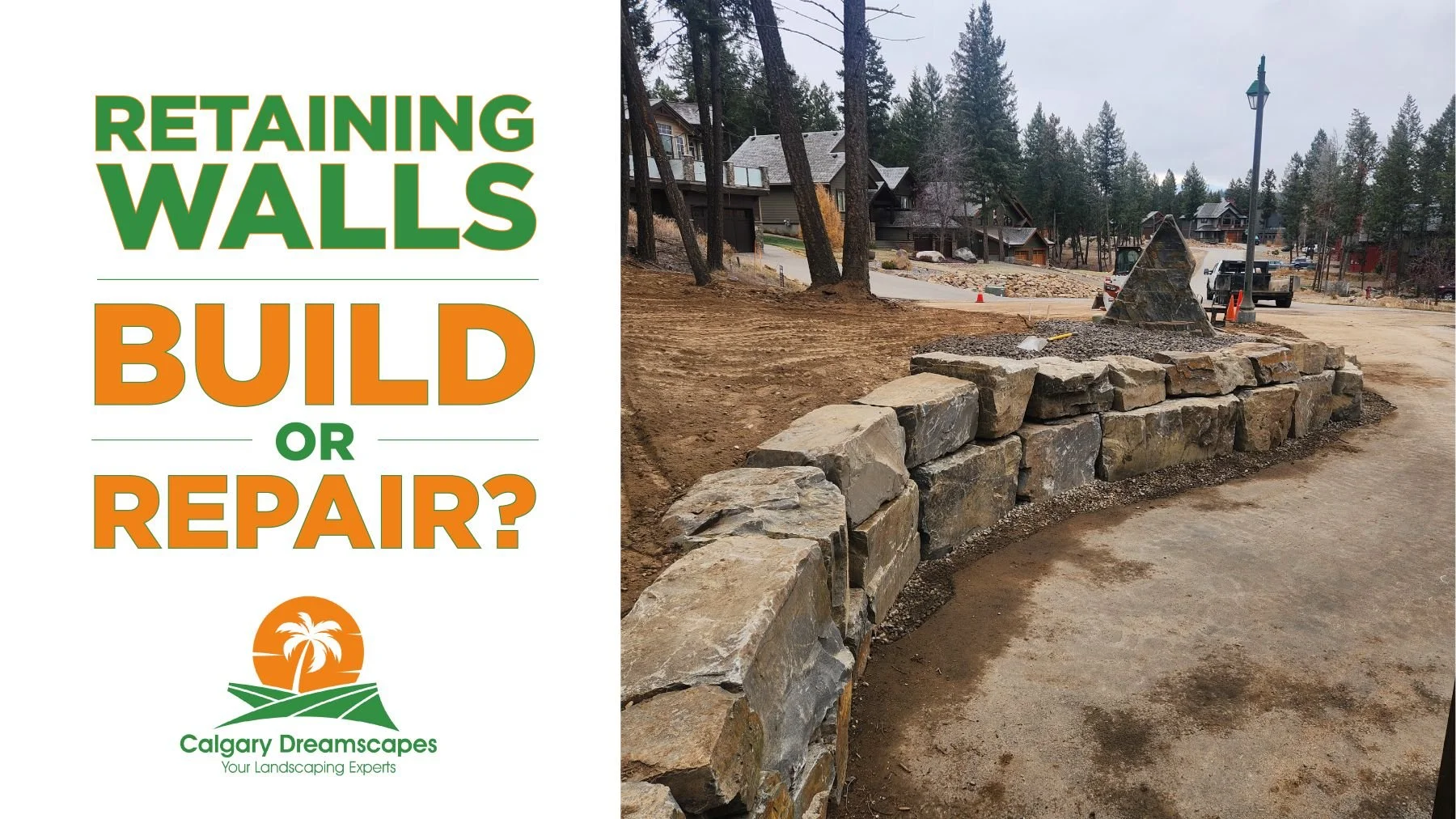
Retaining walls almost always give you a warning before they fail. As Calgary landscape specialists, we've repaired and replaced many failing walls over the years, and most showed clear warning signs well before they failed. Below, we explore various warning signs on the health of retaining wall as well as when it might be time to repair or rebuild it anew.
Also See:

Warning signs that a retaining wall is failing
The clearest sign of a failing retaining wall is movement: the top of the wall tips toward you, the face bulges out, the bottom washes outward, or cracks get wider from one season to the next. Another big clue is water or soil showing up in your yard where it shouldn't.
Walk along your wall after a heavy rain or during the spring melt. Look for:
The top of the wall leaning toward you
A bulge partway along the face
Cracks or gaps that are growing
Cap stones sliding off
Soil washing out between the blocks or at the bottom
Wet spots, ice or water seeping through the face
Cracks in the lawn or a sinking patio above the wall
Soft or rotting wood in timber walls, especially in the bottom rows
One thing that surprises people: many block retaining walls are built to tilt slightly back into the hill on purpose. If yours now tips toward you, it has moved.
How to test if a retaining wall is moving
Here's a simple way to track it. Photograph the wall from the same spots, holding a level against it, and write the date on each photo. Repeat after the next freeze-thaw cycle. If anything has changed, the wall is still moving.
These photos are the most useful thing you can show a landscaping contractor when deciding whether to repair or replace the wall.
What does each sign usually mean?
A lean or bulge usually means the wall is being pushed harder than it can handle, often by water. Treat it as urgent: keep heavy loads away from the wall and have it inspected.
Cracks or blocks pulling apart can come from settling or frost. Measure and photograph them monthly to see whether they're growing.
Soil leaking through the joints usually means there's no filter fabric or gravel behind the wall to hold the soil back.
Dry drain pipes with a wet wall face mean the drain is blocked or missing.
Cracks in the lawn or patio above the wall mean the soil behind it is moving. Stop using that area and get a professional assessment right away.
Seeing any of these signs and would rather not tackle it yourself? Give Calgary Dreamscapes a call, and we'll come take a look.
Why do retaining walls fail in Calgary?
Most walls fail because of water, a poor base, too much weight or aging materials, and Calgary's climate makes the water problem worse.
Water: Wet soil is much heavier than dry soil, so it pushes harder on the wall. That's why building codes require more strength where soil can't drain.
Freeze-thaw cycles: At the Calgary airport, the temperature drops below freezing overnight on about 194 days a year, but stays below freezing all day on only about 59. That means the temperature swings above and below zero on roughly 135 days a year (Environment and Climate Change Canada). With each swing, trapped water freezes, expands and pushes against the wall.
A weak base: A retaining wall needs a firm, compacted gravel base, with part of the bottom row buried below grade. It is recommended to reinforce the wall by setting it in a deep trench about 600 mm (24 in) wide and 150 mm (6 in) deep, and by digging out soft clay or wet soil under the base and replacing it with compacted gravel.
Too much weight above: A patio or driveway on top of a retaining wall adds significant weight and pressure. In situations where significant forces will be applied, even if your retaining wall is shorter than 4 feet (the bylaw requirement for an engineered plan), it’s always best to consult with an engineering firm. This won’t cost much; likely anywhere between $300 and $600 or more depending on the company you use.
Terraces built too close together: Several short walls stacked close together can act like one tall wall, creating unexpected pressures that reduce the system’s overall integrity.
Aging timber: Wood walls rot over time, especially in the bottom rows, which is why we almost always recommend using blocks or natural stone for retaining walls in Calgary.
How should drainage behind a retaining wall work?
A well-draining retaining wall has four essential parts:
Clean crushed stone directly behind the wall
A perforated pipe at the bottom to collect water
An outlet where that water can drain away
A yard graded so rain doesn't pour over or behind the wall
It is recommended to have at least 300 mm (12 in) of clean stone behind the blocks, and a drain pipe for taller walls and wet sites, with an outlet at least every 15 m (50 ft). The City's Guide to Lot Drainage also says water should be directed away from walls.
There are three things you can check yourself:
· Where do your downspouts, sump pump and sprinklers send water?
· Do the drain outlets at the bottom of the wall run after rain?
· Does your yard slope toward the wall?
At Calgary Dreamscapes, every retaining wall project starts with a site visit to see how water moves across your yard. That's the same information you need to decide whether to repair or rebuild, and if the fix is regrading or a new drain, we can handle that too.
Can a leaning retaining wall be repaired, or does it need to be rebuilt?
Sometimes a retaining wall can be repaired, especially when the damage is limited to one area, the base is still solid, and the cause (usually water) can be fixed.
A repair is worth considering when:
Only the top few rows have shifted
The bottom row is still straight
Your photos show no change over a full season
The cause is clear, such as a blocked drain or a downspout emptying behind the wall
A rebuild is usually the smarter choice when:
The bottom row has tipped, sunk or cracked
The wall leans along most of its length
There's no gravel or drain pipe behind it
The timbers are rotting
The wall now supports something it wasn't built for, like a driveway or hot tub
It has been patched before and moved again
If you're rebuilding, consider natural stone. A well-built natural stone wall can last decades with minimal maintenance.
Bring in a professional landscaping company and/or engineer for tall retaining walls above 4 ft, walls supporting a house, driveway or neighbour's yard, and walls with anchors tied back into the soil. Replacing those anchors can also sometimes require a permit.
Tearing out an old wall and building a new one is heavy, messy work. If you'd rather not spend your weekends hauling block, Calgary Dreamscapes can handle the tear-down and rebuild for you.
Do you need a permit to repair or rebuild a retaining wall in Calgary?
Often, yes. The City of Calgary requires a building permit for any wall that holds back 1.2 m (4 ft) of soil or more. If two walls or garden boxes are within 1 m of each other, the City adds their heights together.
Repairing a retaining wall may also require a permit, including repairs to failed walls or walls being torn down. Under Alberta's safety codes, repair work counts as construction.
As of October 2026, the City's building permit fee for a retaining wall is ~$210, with a processing time of about 7 days. The same fee applies to work on an existing wall.
A development permit is separate from a building permit; it's the City's approval of where and how something is built. Walls under 1.2 m usually don't need one. Walls 1.2 m or taller, or designs that don't meet the City's rules, do. As of October 2026, a development permit costs $579 and can take 10 to 12 weeks or more.
A few details about retaining walls that Calgary homeowners often miss:
A permit expires 180 days after it's issued.
The retaining wall must be finished, including any railings, before the City inspects it.
A wall 600 mm (2 ft) or more above the adjacent ground and near a sidewalk or public path needs a railing or sturdy fence.
Complex walls, or walls that cross two or more lots, may need a permit and an engineer's stamp even if they're shorter than 1.2 m.
Airdrie, Okotoks, Cochrane, Rocky View County and Foothills County set their own rules, so check with your municipality first.
What affects the cost of retaining wall repair or replacement?
The price depends on the wall's height and length, how easy the site is to access and what has to be removed. Drainage and engineering also add to the cost. We don't publish prices because every yard is different; a site visit is the only way to get an accurate number.
The main cost factors are:
Height and length, and whether the wall needs geogrid reinforcement buried in the soil
Removing the old wall and any saturated soil behind it
Getting equipment into tight side yards
Gravel, filter fabric, drain pipe and a drainage outlet
Your choice of natural stone or concrete block
Engineering and municipal permit associated fees
Want an accurate number for your yard? We're happy to come out and give you one.
Ready to Rebuild a Failing Retaining Wall in Calgary?
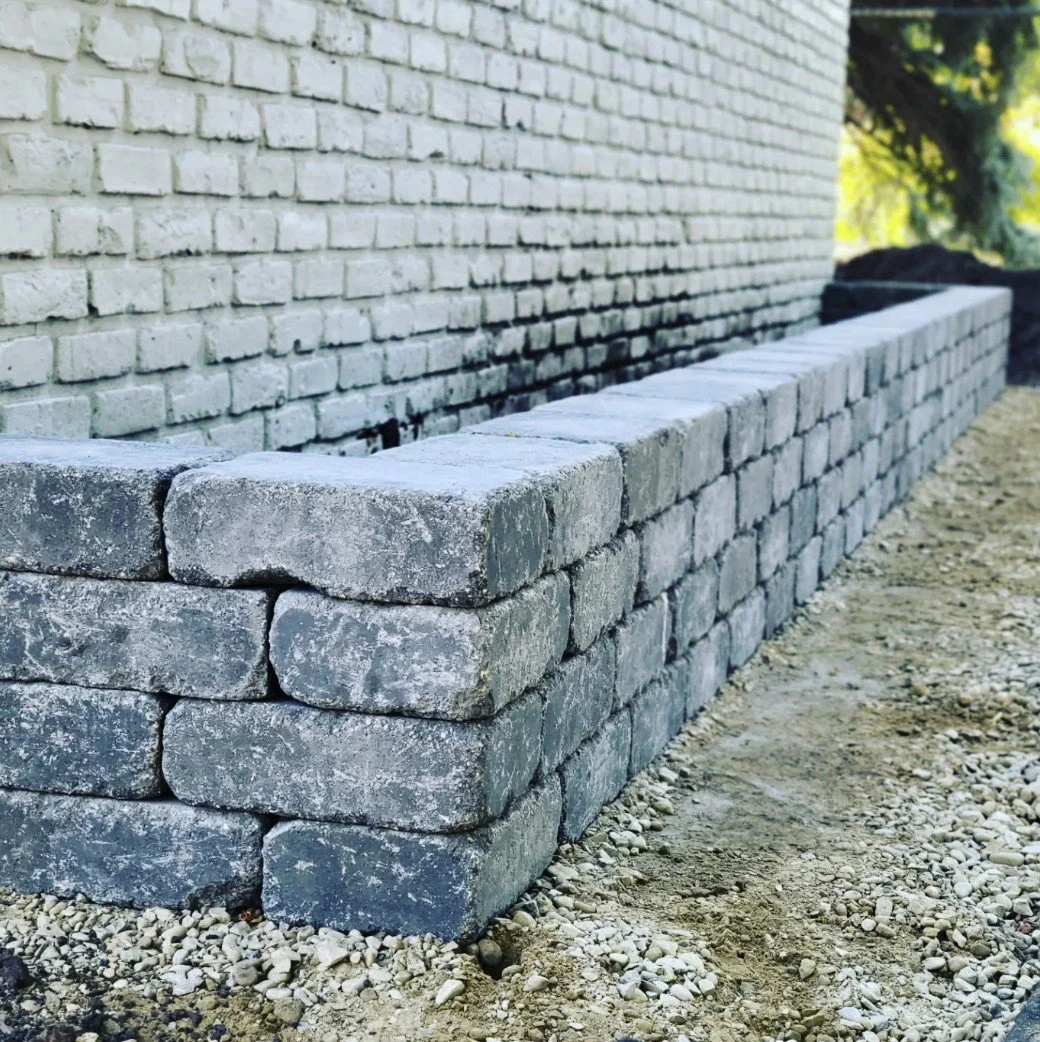
Previous project retaining wall in Calgary
If your wall is leaning, bulging or losing soil, let Calgary Dreamscapes take a look. We build natural stone and concrete block retaining walls across Calgary and the surrounding area, including Airdrie, Okotoks and Cochrane. Every project starts with a site visit to check drainage, slopes and water flow, and our estimates are always free with no obligation.
Call (403) 471-7588, email richie@calgarydreamscapes.ca, or visit our retaining walls page to request your free quote.